 Ummati Islamic Website
Related Articles



This article below highlights the contribution of Deoband in blowing out the forces of baatil. Before reading the article we need to clarify a particular misconception that generally is in the minds of the public that: “Every person who studied at a Deoband institute is a Deobandi“. The article makes the reader understand that Deoband began on Haqq and that is what is referred to when we speak of “Ulama-e-Deoband”, the initial Ulama of Deoband and those who continue to follow in their footsteps. The golden age of yesteryears Deoband is not the Deoband of today. Further, it does not mean only those who studied at Deoband are Deobandi but rather any institute which does not only say it in their goals but actively strives to make it a living reality to protect and defend the Shariah under the guidelines of the real Deoband is what is really referred generally.
You will hear many people using titles at major events to advertise an agenda introducing the now liberal scholar as “Traditional scholar” or “Deobandi” to sanction Haraam. As such you will think that the Deobandi Madressah that the person completed allows all this Haraam but that is just a whitening cream for the dark agenda. At times when the so called Deobandi Madressah shifts away from the Shariah then they should also remove the title of Deobandi because the teachings that Darul Uloom Deoband began on in essence was only the Shariah. People may seek to turn into a cult and pollute its true teachings but we have to remain with that which will always remain and that is the Shariah!
Upon occasion a person said to the principal of Darul Uloom Zakariyya, Moulana Shabbier Saloojee حفظه الله, “this person studied at Darul Uloom Zakariyya“. Moulana said, “that person did not study at the Darul Uloom“. The person insisted and provided evidence too. However, onlookers understood what Moulana meant and explained that, “although Moulana knows that the person did study physically but a person who does not adhere to the teachings of the Shari’ah taught then in practice it is as if he has not studied there.
Recently we have seen letters which were made public signed by Moulana Shabbier Saloojee and Mufti Ridhaaul Haqq Saheb حفظهما الله, to warn the public of certain students who completed the Iftaa course at Darul Uloom Zakariyya, but they had their Mufti titles quickly retracted as they were roaming around attempting to justify their immature acts on Tiktok. More will have to be written on this on another occasion in shaa Allah:
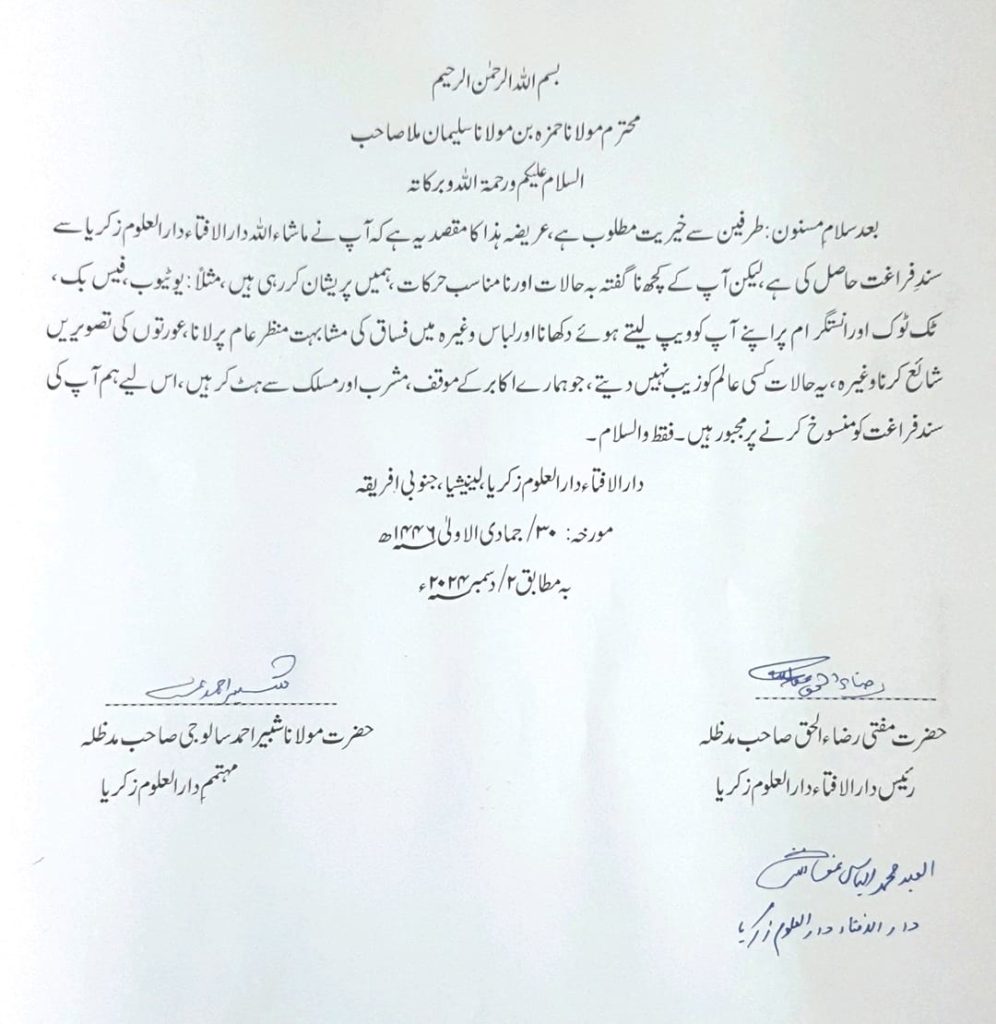
What is mentioned in the above letter?
Hazrat Mufti Razaul Haq Sahib rescinds the certification given to Ml Hamzah Moolla of Lenasia
Due to various reasons that are against Shari’ah and the Maslak of our Akaabir, like the act of appearing on social media in videos in the dressing and appearance of the Fussaq and sharing pictures of strange women, Mufti Razaul Haq and Moulana Shabbir Saheb along with Mufti Ilyas Shaikh have rescinded his Ijazat in Iftaa.
May Allah Ta‘ala save us all and forgive us for our shortcomings.
Another example of this is below:
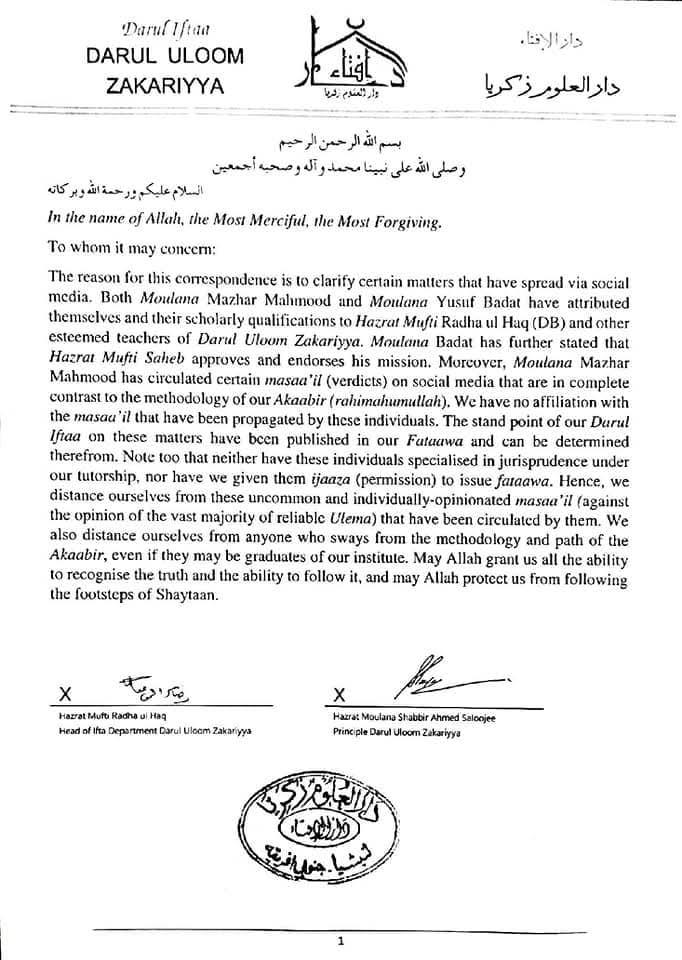
We must plead to Allah Taa’alaa that these people come on to the Haqq. This should not be for the superior feeling but just to warn the public when you use titles for the wrong then Allah Ta’alaa then snatches it from you too. We too should be concerned that we could slip harder. This is vitally important. Allah Ta’alaa save us!
Similarly if prominent Shuyookh of Deoband start to fantasize about practices of the Hindus, Shias and the collective call of interfaith then they are really using the name of Deoband for the call of Satanism.
This post on Deoband can be found on Telegram by the writer, Ahqar al-Haqir:
On this monumental day 30th May 1866 a legacy was born with the divine help of ALLAH, the blessed hands of luminaries like Muhammad Qasim Nānautvī, Fazlur Rahman Usmānī, Sayyid Muhammad Abid, Rashid Ahmad Gangohi, and many others رَحِمَهُمُ اللهُ laid the foundation of Darul Ulüm Deoband not merely an Islamic seminary, but a sacred resistance, a revivalist force, and a spiritual army for the Ummah.
This was not just the birth of a madrasah it was the continuation of the spirit of جهاد alongside علم for this movement itself emerged from the fires of resistance against colonial kufr. It was born from the battlefield, forged by those who had already shed their blood and sacrificed their comfort في سبيل الله. That legacy of both intellectual and physical, runs through its very veins, making Deoband not only a citadel of scholarship but also a symbol of sacred struggle.
Darul Ulum Deoband, nestled in the humble town of Deoband, Saharanpur (U.P., India), grew into a mighty institution a global torchbearer of Sunni Islam. Through its halls passed imāms, mujahidin, muhaddithin, fuqahā, and leaders who rekindled the flame of Qur’an and Sunnah in an era overshadowed by darkness.
This was the movement that preserved the faith, upheld the truth, and defended the honour of the Ummah, in the madāris and even on frontlines. It stood as a sword against oppression and a shield of sacred knowledge.
Indeed, it is one of the most unique gifts to this Ummah a blend of sincerity, knowledge, and sacrifice ماشاء الله
Dār al-‘Ulūm Deoband was a practical manifestation of the religious foresight and scholarly brilliance of Ḥujjāt ul-Islām Ḥaḍrat Mawlānā Muḥammad Qāsim Nānautawī رحمه الله. After the failure of the 1857 Revolution, when Muslims were in a state of extreme helplessness, Mawlānā Nānautawī رحمه الله laid the foundation of a religious center whose purpose was to preserve Islamic values and to prepare such a group against the tyrannical British Empire that would revive the lost glory of the Muslims.
Sayyid Maḥbūb Riḍwī writes: “At that time, it was concluded that in order to keep the religious consciousness of Muslims alive and to maintain their national unity, the establishment of a religious and scholarly seminary was indispensable. Hence, it was decided that instead of Delhi, this seminary should be established in Deoband.”
When Ḥājī Imdādullāh Muhājir Makkī (رحمه الله) was informed that a madrasah had been established in Deoband, he remarked: “Subḥān Allāh! You say, we have established a madrasah. Do you not realize how many foreheads, during the hours of dawn, fell into prostration and earnestly cried: ‘O Lord! Create a means for the survival of Islām and preservation of knowledge in Hindustān.’ This madrasah is the fruit of those dawn-time supplications.”
After the failure of the 1857 جھاد movement, the strategy adopted by Mawlānā Nānautawī رحمه الله was based on the following core principles and objectives:
- Inviting towards Islamic sciences and arts based on the pedagogical style of Shāh Waliyyullāh Mujaddid Dahelwī رحمه الله.
- Refuting the doubts and suspicions about Islām spread by Christians and Hindus.
- Striving to spread the teachings of the Qur’ān and Sunnah among both Muslims and non-Muslims.
- Awakening Islām without seeking aid from the occupying and imposed government, rather spending one’s own wealth and life.
- Reviving Shāh Waliyyullāh’s philosophy in a renewed manner to establish Islamic dominance in Hindustān.
- Delving deeply into traditional sciences to align them with the intellectual mindset of the Indian people.
- Avoiding the “specific terminologies” of philosophical experts and instead communicating in the common language of Indians.
- Awakening organized intellectual consciousness and the spirit of جھاد في سبيل الله.
Dār al-‘Ulūm Deoband was established to fulfill these principles and objectives.
Mawlānā Nānautawī رحمه الله himself said: “We have veiled the actual purpose of Dār al-‘Ulūm behind the curtain of teaching and dissemination of Islamic sciences.”
Accordingly, Ḥaḍrat Shaykh al-Hind Mawlānā Maḥmūd Ḥasan رحمه الله the first student of this madrasah once said: “Did Ḥaḍrat al-Ustādh establish this madrasah merely for teaching and learning? I witnessed the establishment of this institution firsthand. To the best of my knowledge, after the failure of the 1857 uprising, the intention was to establish such a center through which people could be prepared to compensate for the failure of 1857.”
He further stated: “I do not oppose those whose goal and aim is teaching and learning. But for myself, I chose the very path for which, in my view, Ḥaḍrat al-Ustādh established this system of Dār al-‘Ulūm.”
Mawlānā Munāẓir Aḥsan Gīlānī رحمه الله, writing on the background of the establishment of Dār al-‘Ulūm, notes: “When he (Mawlānā Nānautawī) and his companions apparently returned unsuccessfully from the battlefield of Shāmilī, it was certainly not a return in despair or hopelessness, nor could it be. Indeed, they returned, but certainly in the manner described in the Qur’ān (Al-Anfāl 8:16):
مُتَحَرِّفًا لِقِتَالٍ أَوْ مُتَحَيِّزًا إِلَىٰ فِئَةٍ
‘Turning aside for fighting or retreating to a company’ — and surely, this was the reason for their return.”
Describing the establishment of Dār al-‘Ulūm as preparation for a new battlefield against British colonialism, he writes: “After the failure of the 1857 conflict, his (Mawlānā Nānautawī’s) mind became occupied with preparing new fronts and fields for the struggle and combat. The educational system of Dār al-‘Ulūm Deoband was the most prominent and central element of this plan.”
It was a movement based on the path shown by the Messenger of Allāh ﷺ, calling for an organized struggle to establish a free Islamic system. Hence, the freedom struggle of our elders and their sacrifices against the tyrannical and taghūti forces of the time are living examples of this ideology.
The principles laid down by Mawlānā Nānautawī رحمه الله for Dār al-‘Ulūm Deoband are famously known as the “Eight Fundamental Principles” (Uṣūl-e-Hashtgānah). Below, we discuss only the first principle, whose first clause states: “With freedom of conscience, the proclamation of the word of truth (kalimat al-ḥaqq) must be upheld at all times. No golden temptations, paternal pressures, or patronizing favors should hinder this.”
Unfortunately today, except for a few institutions, most of our madrasahs do not fully live up to this principle. Gradually, the capacity to raise the word of truth (kalimat al-ḥaqq) against the Ṭāghūt and tyrannical powers is diminishing in our institutions.
Dār al-‘Ulūm Deoband was not merely established for teaching. It was built to compensate for the great losses Muslims suffered during the جھاد of 1857. After its failure, the Muslims of Hind were living in destitution, while Christian missionaries were mockingly attacking the symbols of Islām and actively converting Muslims. This demanded the formation of a center where the religious, political, and moral training of Muslims could be conducted, and where such individuals could be prepared who would avenge the defeat suffered in the war.
Thus, the purpose of founding Dār al-‘Ulūm was not just teaching and learning, but to establish a center where the remaining individual capacities of Muslims could be gathered into a collective force. This force would revive and complete the mission left unfinished by Ḥaḍrat Sayyidīn (رحمهما الله). The lives and character of Ḥājī Imdādullāh Muhājir Makkī, Mawlānā Rashīd Aḥmad Gangohī, and Mawlānā Nānautawī رحمهم الله testify that a major portion of their lives was spent in intellectual and practical جھاد against British rule.
O ALLAH! Return Umm al-Madāris, Dār al-‘Ulūm Deoband, to the very purpose for which it was established. Make it a fortress for the exaltation of Your word, a center for the revival and resurgence of Your Dīn. Grant it sincere scholars and students, with pure intentions and firm resolve. Protect it from every deviation that distances it from Your path. Make it a light in darkness and a voice of truth in times of silence, Āmīn ya arhamar rāhimīn !
